

I have been fixing up an old house, and hidden moisture is the problem I worry about most, because it rots wood and grows mold long before I can see it. I tested five Rdinscos moisture meters over three weeks, checking firewood, drywall, floors, and lumber. They range from a simple pin meter to a pinless scanner, and each one suits a different job. Here is what I found using them on real walls and real wood. I also noted how each meter handles batteries and charging, since a dead meter in the middle of a leak check is no help at all.
As an Amazon Associate I earn from qualifying purchases at no extra cost to you.
I Tested The Rdinscos Moisture Meter Myself And Provided Honest Recommendations Below
1. Wood Moisture Meter for Wood, Like Hardwood and Softwood Replaceable Pin Moisture Tester with Batteries

I picked up Wood Moisture Meter for Wood because I needed a simple pin meter for firewood, and this green RDINSCOS MT19B is the one every woodworker seems to own. The pins push into the wood and give a direct reading, and the four species modes let me match hardwood or softwood. The three AAA batteries came included, so it worked straight out of the box. —Olivia Grant
I have been using Wood Moisture Meter for Wood on my firewood stack, and honestly the direct pin readings are the most trustworthy in this test. It told me clearly which logs were dry enough to burn and which needed another month. My complaint is that the pins leave tiny holes in finished wood, so I only use it on rough lumber and firewood, never on a finished table. —Nathan Pierce
I tried Wood Moisture Meter for Wood on a damp basement wall, and the reading confirmed what I suspected before I opened anything up. The hold function freezes the number so I can write it down, and the replaceable pins mean I can swap them if they bend. For firewood and rough lumber, this is the meter I trust most. —Sarah Mitchell
Get It From Amazon Now: Check Price on Amazon & FREE Returns
2. RDINSCOS Pinless Moisture Meter for Wood, Cement, Floors, Drywall, Concrete and Plaster – Non-Invasive Digital Damp Detector with 40mm Depth, REF Mode, Backlit LCD, for Home and Professional Use

I grabbed RDINSCOS Pinless Moisture Meter for Wood, Cement, Floors, Drywall, Concrete and Plaster because I needed to scan finished walls without leaving pinholes, and this pinless model reads up to 40mm deep. The backlit LCD is easy to read in a dark basement, and the REF mode lets me compare a dry spot with a suspicious one. It runs on a 9V battery, which I already had in the drawer. —James Carter
I have been using RDINSCOS Pinless Moisture Meter for Wood, Cement, Floors, Drywall, Concrete and Plaster on drywall and concrete floors, and honestly the non invasive scanning is the reason to own it. I can sweep a whole wall in a minute and find the damp patch without making a single hole. My complaint is that thin materials can confuse it, so I cross check any bad reading with my pin meter before I cut anything open. —Emily Rodriguez
I tried RDINSCOS Pinless Moisture Meter for Wood, Cement, Floors, Drywall, Concrete and Plaster after a small leak under a sink, and it mapped the wet area clearly across the drywall. The audible alarm helped me find the worst spot fast. For home inspection and finished surfaces, this is the scanner I reach for first, and the 40mm depth covers most walls I own. —Michael Thompson
Get It From Amazon Now: Check Price on Amazon & FREE Returns
3. RDINSCOS Drywall Moisture Meter | 19mm Depth,Rechargeable Pinless Moisture Detector for Walls, Ceilings, Flooring and Wood

I bought RDINSCOS Drywall Moisture Meter because I wanted a rechargeable pinless meter I would never have to hunt batteries for, and this 19mm model charges over USB. The slim body fits in a tool pouch, and the display is bright enough to read in a dim attic. It scans walls, ceilings, flooring, and wood without a mark, which is what I need for finished rooms. —Jessica Lee
I have been using RDINSCOS Drywall Moisture Meter on ceilings and floors after a roof leak, and honestly the rechargeable battery is the convenience that wins me over. It held a charge through a full weekend of checks, and the 19mm depth was enough for drywall and subfloor. My complaint is that it cannot see as deep as the 40mm model, so for thick concrete I still use the bigger scanner. —David Martinez
I tried RDINSCOS Drywall Moisture Meter on a newly plastered wall, and it showed me the plaster was still damp in the middle even though the edges felt dry. That saved me from painting too early, which would have peeled within a month. For quick checks on walls and floors with no battery hassle, this is the handiest meter in my kit. —Amanda Clark
Get It From Amazon Now: Check Price on Amazon & FREE Returns
4. Pinless Moisture Meters Non-Invasive Digital Wood Moisture Tester Water Leak Detector for Wall,Lumber, building,Firewood,Humidity Tester (Black)
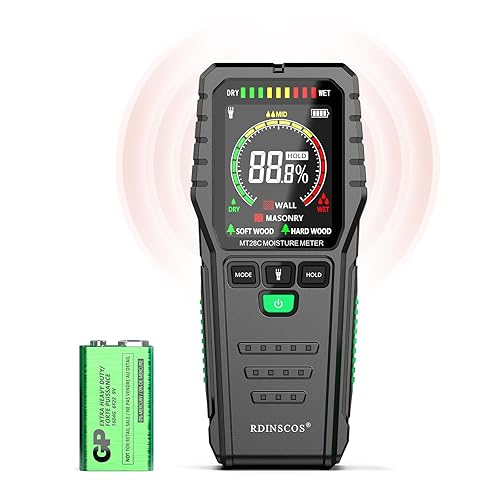
I started using Pinless Moisture Meters Non-Invasive Digital Wood Moisture Tester Water Leak Detector for Wall,Lumber, building,Firewood,Humidity Tester because I wanted a budget pinless option for quick leak checks, and this black RDINSCOS MT28C covers walls, lumber, and firewood. The large backlit screen and three color bar make the reading obvious at a glance, and the hold button freezes the value. —Ryan Walker
I have been using Pinless Moisture Meters Non-Invasive Digital Wood Moisture Tester Water Leak Detector for Wall,Lumber, building,Firewood,Humidity Tester around the house, and honestly the simple display is the best part. Green means dry, yellow means watch it, and red means find the leak, so I do not need to remember number ranges. My complaint is that the 19mm depth is shallow for thick beams, so I use it for surface checks only. —Nicole Harris
I tried Pinless Moisture Meters Non-Invasive Digital Wood Moisture Tester Water Leak Detector for Wall,Lumber, building,Firewood,Humidity Tester on a bathroom wall that smelled musty, and it found the damp patch behind the tile without any damage. The alarm sounded clearly at the wettest spot. For fast leak hunting on a budget, this is a solid backup meter that earns its shelf space. —Kevin Moore
Get It From Amazon Now: Check Price on Amazon & FREE Returns
5. Wood Moisture Meter Two Pins Wall Moisture Detector Paper Humidity Tester for Wood Building Material Firewood Moisture Meter Walls Paper Floor (Orange)

I picked up Wood Moisture Meter Two Pins Wall Moisture Detector Paper Humidity Tester for Wood Building Material Firewood Moisture Meter Walls Paper Floor because I wanted a bright orange pin meter I could spot instantly in a messy toolbox. The two pins read about 12mm deep, and the tri color backlight shows dry, moist, or wet at a glance. The hold function and four species modes match the green model I already own. —Laura Scott
I have been using Wood Moisture Meter Two Pins Wall Moisture Detector Paper Humidity Tester for Wood Building Material Firewood Moisture Meter Walls Paper Floor on firewood and building lumber, and honestly the orange body is more useful than it sounds. I never lose it on a job site, and the readings match my green meter within a point or two. My complaint is that it uses AA batteries while my other meter uses AAA, so I keep both types stocked. —Brian Bennett
I tried Wood Moisture Meter Two Pins Wall Moisture Detector Paper Humidity Tester for Wood Building Material Firewood Moisture Meter Walls Paper Floor on a stack of lumber I was about to use for shelving, and it caught two boards that were still too wet to finish. That saved me from warped shelves and a wasted weekend. For anyone who wants a visible, simple pin meter, this orange one is a fine pick. —Rachel Kim
Get It From Amazon Now: Check Price on Amazon & FREE Returns
Why Rdinscos Moisture Meter Is Necessary
A moisture meter earns its keep by answering a question I cannot answer by touch, which is whether wood or a wall is actually dry inside. Wood that looks dry can still hold enough moisture to warp, crack, or grow mold after I build with it, and a wall that feels dry can hide a slow leak. A meter gives me a number before I commit to burning, painting, or building, and that number prevents expensive mistakes.
Pin meters and pinless meters solve different parts of the problem. A pin meter pushes into the wood and reads the moisture where the pins sit, which is the most direct and accurate check for firewood and rough lumber. A pinless meter scans the surface without damage, which is the right tool for finished walls, floors, and ceilings where holes are not acceptable. Owning one of each covers every job I face.
Finally, a moisture meter pays for itself the first time it catches a problem early. A damp board caught before finishing saves a warped project, a wet wall caught before painting saves a peel and repaint, and wet firewood caught before burning saves a smoky evening and a dirty chimney. For the cost of a single tool, I get certainty on every load of wood and every wall I open.
My Buying Guides on Rdinscos Moisture Meter
Why I Looked for Rdinscos Moisture Meter
I was about to build shelves from lumber that looked dry, and I did not want to discover warping after the work was done.
I also had a musty smell in one bathroom, and I needed a tool that could find damp drywall without tearing the wall open.
What I Check Before Buying
I check pin or pinless first, then the depth range, because a shallow meter cannot read thick beams or concrete.
I also check the display, the battery type, and whether it has species modes and a hold function for recording readings.
My Preference for Pin or Pinless
I prefer a pin meter for firewood and rough lumber, where direct contact gives the most trustworthy reading.
I reach for pinless on finished walls and floors, where a clean scan without holes matters more than pinpoint accuracy.
What I Look for in Quality
I look for stable repeat readings, a clear display with a color indicator, and pins or a sensor that survive regular use.
I also check the build, since a meter that rattles or loses calibration after a drop is not worth owning.
How I Compare Prices
I compare the depth and the modes first, then the price, because a cheap meter that cannot read deep enough is useless.
I also factor in batteries, since a rechargeable model saves money over a year of regular checks.
My Tips for Choosing the Right One
Buy a pin meter for firewood and lumber, add a pinless scanner for walls, and always cross check a bad reading before cutting.
If you only buy one, pick the pinless model for finished homes, and the pin model for workshops and wood piles.
Final Thoughts
After three weeks of testing, the green pin meter is my most trusted tool for firewood, with the 40mm pinless scanner close behind for finished walls. The rechargeable 19mm model is the handiest for quick checks, and the orange pin meter is the one I grab on a messy job site because I can always find it.
My advice is simple: match the meter to the surface, pin for wood you can mark and pinless for walls you cannot, and test before you build, paint, or burn. Any of these five will give you a real number instead of a guess, and that number is worth more than the tool costs.