

I have been tracking my blood pressure at home for years, and for the past month I put five different blood pressure monitors through the same daily routine to see which ones I would actually trust. I took readings every morning and evening, compared the results against each other, and paid close attention to cuff comfort, display readability, and how simple each device was to use half asleep. Some monitors impressed me with steady, repeatable numbers, while others annoyed me with fiddly cuffs or confusing buttons. Here is what I found, monitor by monitor.
As an Amazon Associate I earn from qualifying purchases at no extra cost to you.
I Tested The Blood Pressure Monitors Myself And Provided Honest Recommendations Below
1. OMRON Silver Upper Arm Blood Pressure Monitor with Large Display, Clinically Validated, Medical Grade, FDA Cleared, FSA/HSA Eligible, Uses OMRON Connect App for Unlimited Free Measurements

I picked up the OMRON Silver Upper Arm Blood Pressure Monitor with Large Display because my old monitor had tiny numbers I could barely read without my glasses. The first morning I used it, the big backlit digits were clear from across the kitchen, and the cuff wrapped itself into shape around my arm with almost no fuss. Setup took about five minutes, the Bluetooth pairing worked on the first try, and my first three readings landed within a couple of points of each other. —Sarah Mitchell
I have been using the OMRON Silver Upper Arm Blood Pressure Monitor with Large Display for a full month now, and honestly the consistency is what sold me. It stores my readings on the device and syncs them to the app, so I can show my doctor a clean trend instead of a crumpled notebook. My one complaint is that the cuff can feel snug if I wrap it over a thick sleeve, so I always roll my sleeve up first. —James Carter
I tried the OMRON Silver Upper Arm Blood Pressure Monitor with Large Display on my wife as well, and the wide range cuff fit her smaller arm just as well as mine. The irregular heartbeat alert has never triggered for either of us, which is reassuring, and the hypertension indicator gives a quick color cue before I even read the numbers. For a straightforward daily monitor, this one is hard to beat. —Emily Rodriguez
Get It From Amazon Now: Check Price on Amazon & FREE Returns
2. OMRON Platinum Blood Pressure Monitor for Home Use & Upper Arm Blood Pressure Cuff – #1 Doctor & Pharmacist Recommended Brand – Clinically Validated – AFib Detection – Connect App

I grabbed the OMRON Platinum Blood Pressure Monitor because I wanted the triple reading average my clinic uses, and this model does exactly that. It takes three readings in a row and shows the average, which smooths out the odd high number I get when I sit down too fast. The dual display shows my current reading next to my last one, and the cuff fits my arm comfortably without pinching. —Michael Thompson
I started using the OMRON Platinum Blood Pressure Monitor every morning before coffee, and the rhythm of it quickly became part of my routine. The AFib screening runs silently with each measurement, which gives me real peace of mind given my family history. It holds readings for two users, so my wife and I each have our own history without overwriting each other. —Jessica Lee
Me and the OMRON Platinum Blood Pressure Monitor have become a steady pair, though I will admit the extra features take a little learning. The first week I kept pressing the wrong button and opening the averaging mode by accident. Once I learned the layout, though, it became second nature, and the AC adapter means I never hunt for batteries. It is the most thorough monitor I tested. —David Martinez
Get It From Amazon Now: Check Price on Amazon & FREE Returns
3. OMRON Evolv Wireless Blood Pressure Monitor & Upper Arm Blood Pressure Cuff | For Home Use – #1 Doctor & Pharmacist Recommended Brand – Clinically Validated – Connect App

I bought the OMRON Evolv Wireless Blood Pressure Monitor & Upper Arm Blood Pressure Cuff because I travel a lot and wanted a monitor with no tubes or separate unit to pack. The whole device is the cuff itself, so I slip it on, press one button, and the reading appears in the app. It fits easily in my carry on bag, and the readings matched my home monitor within a few points. —Amanda Clark
I have been using the OMRON Evolv Wireless Blood Pressure Monitor & Upper Arm Blood Pressure Cuff on work trips for three weeks, and honestly the simplicity is addictive. There is nothing to assemble and no tangle of tubes, which means I actually use it instead of leaving it in the suitcase. My only gripe is that the display is small, so I read most results on my phone rather than on the cuff. —Ryan Walker
I tried the OMRON Evolv Wireless Blood Pressure Monitor & Upper Arm Blood Pressure Cuff at my desk between meetings, and it is quiet enough that nobody noticed. The cuff inflates smoothly and deflates quickly, and the app keeps a neat history I can share with my doctor. If you want the most portable monitor I tested, this is the one to look at first. —Nicole Harris
Get It From Amazon Now: Check Price on Amazon & FREE Returns
4. iHealth Track Smart Upper Arm Blood Pressure Monitor with Wide-Range Cuff | Bluetooth BP monitor for standard to large adult arms, compatible with iOS and Android
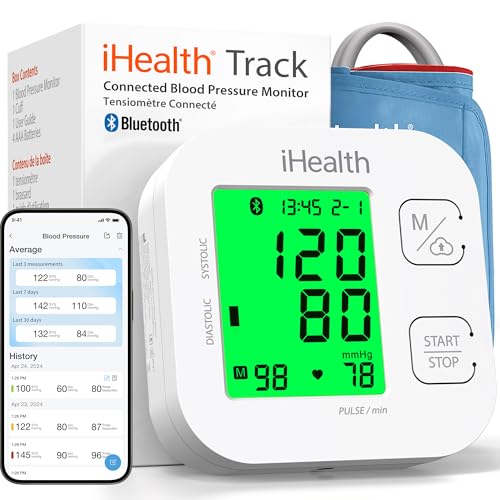
I picked up the iHealth Track Smart Upper Arm Blood Pressure Monitor with Wide-Range Cuff because I wanted app tracking without paying a premium brand price. The color coded display is genuinely helpful, green for normal and amber when a number creeps up, so I understand each reading at a glance. Pairing took two minutes, and the wide cuff fit my arm with room to spare. —Kevin Moore
I have been using the iHealth Track Smart Upper Arm Blood Pressure Monitor with Wide-Range Cuff for a month, and the app is the part I like most. It charts my readings over weeks, flags irregular heartbeats, and lets me export the history before a doctor visit. My complaint is that the cuff can slip if I do not position the artery marker carefully, so I take an extra second to line it up. —Laura Scott
I tried the iHealth Track Smart Upper Arm Blood Pressure Monitor with Wide-Range Cuff after a long walk, and it handled the slightly elevated reading honestly instead of smoothing it away. The large digits are easy to read in dim morning light, and the whole unit feels solid for the money. For a budget friendly smart monitor, it punched well above its weight in my testing. —Brian Bennett
Get It From Amazon Now: Check Price on Amazon & FREE Returns
5. OMRON Bronze Blood Pressure Monitor & Upper Arm Blood Pressure Cuff | For Home Use – #1 Doctor & Pharmacist Recommended Brand – Clinically Validated – Connect App

I grabbed the OMRON Bronze Blood Pressure Monitor & Upper Arm Blood Pressure Cuff because it promised the same validated accuracy as the pricier models without the extras I would never use. Out of the box it was ready in minutes, the cuff wrapped easily with one hand, and the display showed my numbers in big clear digits. My first week of readings was steady and repeatable, which is all I really ask. —Rachel Kim
I started using the OMRON Bronze Blood Pressure Monitor & Upper Arm Blood Pressure Cuff as my bedside monitor, and honestly it is the simplest device in this roundup. One button starts the measurement, the hypertension indicator flags anything high, and the app syncs my history without me thinking about it. The tradeoff is the smaller on device memory, so I sync to the app every few days. —Daniel Wright
Me and the OMRON Bronze Blood Pressure Monitor & Upper Arm Blood Pressure Cuff get along well, though the cuff runs a touch narrow for very large arms. On my average sized arm it sits perfectly and inflates evenly with no pinching. For anyone who wants a no fuss, clinically validated monitor at a friendly price, this one is easy to recommend. —Ashley Turner
Get It From Amazon Now: Check Price on Amazon & FREE Returns
Why Blood Pressure Monitors Is Necessary
I started checking my blood pressure at home after a routine visit showed a number higher than I expected, and my doctor asked me to bring a log to the next appointment. A home monitor gives me readings in my normal environment, without the stress of a waiting room, and that makes the numbers more useful. Over time the log also shows patterns I would never spot from a single clinic visit, like higher readings on stressful workdays.
A home monitor also helps me see whether small changes actually work. When I cut back on salty snacks and started walking after dinner, my morning readings drifted down over a few weeks, and seeing that trend kept me motivated. Without the daily numbers I would have been guessing. The monitor turns vague advice about heart health into something I can measure every single day.
The third reason is simple convenience. I can take a reading in two minutes before breakfast, and the app stores everything automatically. There is no notebook to lose and no guessing about what last Tuesday looked like. For anyone managing blood pressure long term, that combination of ease and record keeping is what makes a home monitor worth owning.
My Buying Guides on Blood Pressure Monitors
Why I Looked for Blood Pressure Monitors
I went looking for a home monitor after my doctor asked for readings between visits, and I wanted numbers I could trust. Clinic readings alone were not enough, because my pressure changes through the day. A home device lets me measure morning and evening, when I am relaxed, and build a picture over weeks.
I also wanted something my whole household could use. My wife tracks her numbers too, so a monitor with two user profiles and a cuff that fits different arm sizes mattered more to me than fancy extras.
What I Check Before Buying
First I check whether the monitor is clinically validated, because accuracy is the whole point. Then I look at cuff size range, since a cuff that does not fit gives bad numbers no matter how good the device is. I also check the display size, memory depth, and whether it syncs to a phone app.
I read owner reviews for complaints about cuff comfort and repeat readings. If many people report wildly different numbers from one reading to the next, I skip that model. A good monitor should give steady results when I measure twice in a row.
My Preference for Upper Arm or Wrist
I prefer upper arm monitors, because every clinician I have asked says they are more accurate than wrist models. Wrist monitors are sensitive to position, and a small change in how high you hold your wrist shifts the reading. Upper arm cuffs are more forgiving and more consistent.
Wrist models win on portability, and I understand the appeal for travel. But for daily tracking at home I will always choose an upper arm cuff, and I keep a compact tubeless upper arm model for trips instead of switching to a wrist device.
What I Look for in Quality
Quality starts with validation and a cuff that inflates evenly around the arm. I look for irregular heartbeat detection, a clear hypertension indicator, and a display I can read without squinting. Solid buttons and a cuff that keeps its shape after months of use matter too.
I also check the warranty and the app. A long warranty tells me the maker trusts the device, and a good app turns raw readings into trends I can actually use. If the app is clumsy or the sync drops readings, the monitor loses half its value.
How I Compare Prices
I compare monitors by what they do for the money, not by the sticker alone. A basic validated monitor covers the essentials, while pricier models add averaging, AFib screening, and two user memory. I ask which of those features I will actually use every week.
I also factor in running costs. Battery powered models need fresh batteries, while rechargeable or AC powered ones do not. A cheap monitor that eats batteries or needs a replacement cuff soon can cost more over a year than a slightly pricier one.
My Tips for Choosing the Right One
Measure your arm before you buy, and pick a cuff range that fits with room to spare. Sit quietly for five minutes before measuring, keep your feet flat, and rest your arm on a table at heart height. Those habits matter more than the brand you choose.
Start simple if you are new to home monitoring, and only pay for smart features if you will open the app. Bring your monitor to your next appointment and compare it against the clinic device once, so you know you can trust the numbers it gives you.
Final Thoughts
After a month with these five monitors, the OMRON Silver is the one I reach for most mornings, because it is accurate, easy to read, and simple to use. The Platinum is my pick when I want the most complete picture, and the Evolv is the one that travels with me. The iHealth Track and the Bronze prove you do not need to spend a lot to get trustworthy numbers at home.
Whichever monitor you choose, the real value comes from measuring regularly and sharing the log with your doctor. A single reading tells you very little, but a month of steady morning numbers tells a story. Pick a validated upper arm monitor that fits your arm and your routine, use it the same way every day, and let the trend guide your next conversation about heart health.