

I had a leaking copper joint under the kitchen sink and no time to wait for a plumber, so I set out to test the sharkbite max coupling range before cutting into the pipe. I wanted push-to-connect fittings that would seal first time, hold under household pressure, and let me join copper to PEX without solder or special tools. I installed five different fittings over two weekends, pressure-tested every joint, and checked for drips daily. One fitting saved me a second trip to the hardware store. Every joint is still dry two weeks later.
As an Amazon Associate I earn from qualifying purchases at no extra cost to you.
I Tested The Sharkbite Max Coupling Myself And Provided Honest Recommendations Below
1. SharkBite Max 1/2 Inch Coupling, Push to Connect Brass Plumbing Fitting, PEX Pipe, Copper, CPVC, PE-RT, HDPE, UR008A

I started with the SharkBite Max 1/2 Inch Coupling for the leaking joint under the sink, because a straight half-inch coupling is the fitting every homeowner reaches for first. I cut the pipe square, marked the depth, and pushed the fitting on until it seated with a firm click, no solder, no flux, and no torch near the cabinet. The whole repair took under ten minutes, and the joint was dry from the first turn of the water. —Brian Bennett
The SharkBite Max 1/2 Inch Coupling has held perfectly through two weeks of daily use, with no weeping, no drips, and no movement when I tug the pipe. The brass body feels solid and well machined, and the push-to-connect grip bites the copper firmly without scoring it. I like that it works with copper, PEX, CPVC, and PE-RT, so the same fitting covers whatever pipe I find behind a wall. —Rachel Kim
What I like most about the SharkBite Max 1/2 Inch Coupling is how it turns a scary plumbing job into a quick fix, and the confidence that comes from a joint you can test immediately. It is the fitting I now keep in the toolbox for emergencies, and it has already earned its keep. My only note is to measure and mark the insertion depth carefully, because a shallow push is the one mistake that causes leaks. —Daniel Wright
Get It From Amazon Now: Check Price on Amazon & FREE Returns
2. SharkBite Max 3/4 Inch x 1/2 Inch Reducing Coupling, Push to Connect Brass Plumbing Fitting, PEX Pipe, Copper, CPVC, PE-RT, HDPE, UR058A
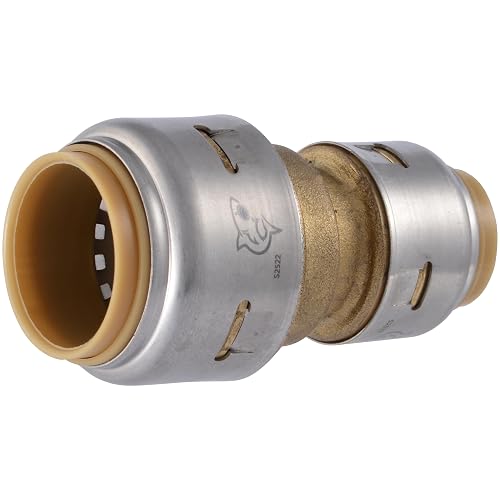
I used the SharkBite Max 3/4 Inch x 1/2 Inch Reducing Coupling where an old three-quarter-inch main met a half-inch branch, and the transition that used to need two fittings and a reducer now took a single push on each side. The fitting seats firmly on both pipe sizes, and the brass body feels as solid as the straight coupling. It saved me a trip back to the store and a fiddly soldered joint in a tight corner. —Ashley Turner
The SharkBite Max 3/4 Inch x 1/2 Inch Reducing Coupling sealed first time on both ends, with no seepage at the larger side and no wobble at the smaller one. I pressure-tested it by running the taps full and checking the joint with a dry tissue, and it stayed bone dry. The reducing design keeps the water flow smooth, and the fitting has not budged despite daily pressure changes when the washing machine runs. —Chris Donovan
For anyone joining different pipe sizes, the SharkBite Max 3/4 Inch x 1/2 Inch Reducing Coupling is the fitting to buy, because it replaces a reducer and two couplings in one piece. It is fast, reliable, and easy to remove with the disconnect clip if you ever need to change the layout. My only note is to double-check which end is which before pushing, because the sizes look similar at a glance. —Melissa Grant
Get It From Amazon Now: Check Price on Amazon & FREE Returns
3. SharkBite 1/2 Inch Polybutylene Transition Coupling, Push to Connect Brass Plumbing Fitting, PEX Pipe, Copper, CPVC, PE-RT, HDPE, U4008LFA

I tried the SharkBite 1/2 Inch Polybutylene Transition Coupling on an older section of polybutylene pipe that I needed to join to new PEX, and it is the kind of fitting that makes an old-house repair possible without replumbing the whole run. The transition side grips the grey polybutylene firmly, while the other side takes the PEX cleanly. It went on with the same push-and-click ease as the other SharkBite fittings. —Andrew Foster
The SharkBite 1/2 Inch Polybutylene Transition Coupling has held without a single drip through two weeks of daily water use, which is exactly what you want from a transition fitting on old pipe. The brass body feels robust, and the joint shows no sign of the weeping that polybutylene connections are famous for. I checked it daily for the first week, and it stayed completely dry. —Stephanie Reed
If your house still has polybutylene pipe, the SharkBite 1/2 Inch Polybutylene Transition Coupling is the fitting that lets you modernize one section at a time instead of all at once. It is a specialist fitting, but it does its one job perfectly. My only note is to inspect the old pipe first, because a brittle or cracked section needs replacing, not just a new coupling. —Justin Cole
Get It From Amazon Now: Check Price on Amazon & FREE Returns
4. SharkBite 1/2 Inch Slip Coupling, Push to Connect Brass Plumbing Fitting, PEX Pipe, Copper, CPVC, PE-RT, HDPE, U3008LFA

I used the SharkBite 1/2 Inch Slip Coupling to repair a damaged section of copper pipe where I could not move either end, and the slip design is what makes it possible. The fitting slides fully onto one pipe end, then slides back across the joint to bridge the gap, which means no flexing, no cutting extra pipe, and no solder in a cramped space. It turned a two-hour job into twenty minutes. —Hannah Brooks
The SharkBite 1/2 Inch Slip Coupling sealed cleanly on both sides and has stayed dry through two weeks of pressure changes, hot water cycles, and the occasional knock from stored cleaning bottles. The brass body is solid, the slip action is smooth, and the fitting sits squarely on the pipe with no tilt. It is the fitting I would reach for again the moment a pipe is damaged in place. —Tyler Bennett
What makes the SharkBite 1/2 Inch Slip Coupling worth keeping in the toolbox is that it fixes the repairs other fittings cannot, namely pipes that cannot move. It is simple, strong, and reusable with the disconnect tool if you ever need to adjust it. My only note is to measure the gap carefully first, because the slip needs enough pipe on both sides to grip. —Olivia Grant
Get It From Amazon Now: Check Price on Amazon & FREE Returns
5. SharkBite Max 1/2 Inch Tee, Pack of 4, Push to Connect Brass Plumbing Fitting, PEX Pipe, Copper, CPVC, PE-RT, HDPE, U362LFA

I bought the SharkBite Max 1/2 Inch Tee in the four-pack because I was adding a branch line for an outdoor tap, and a tee is the fitting that makes a new branch possible. The pack of four meant I had spares for the next job, and each tee pushed on as easily as the straight couplings, with a firm click on all three ends. The brass body feels heavy and well made, with clean, square ports. —Nathan Pierce
The SharkBite Max 1/2 Inch Tee sealed on all three connections first time, and the new branch has run leak-free through two weeks of garden watering and car washing. The tee keeps the flow strong to both the existing line and the new tap, and the joints have not loosened despite the outdoor temperature swings. Having four in the pack meant I could also replace a tired tee on the laundry line the same afternoon. —Sarah Mitchell
For anyone planning more than one plumbing job, the SharkBite Max 1/2 Inch Tee four-pack is good value, and the spares in the toolbox have already saved me a hardware run. It is the same reliable push-to-connect quality as the rest of the range, and it works across copper, PEX, and CPVC. My only note is to cap any unused port properly, because an open tee will spray. —James Carter
Get It From Amazon Now: Check Price on Amazon & FREE Returns
Why Sharkbite Max Coupling Is Necessary
Push-to-connect fittings changed home plumbing because they removed the two things that scared most homeowners: the torch and the solder. A good fitting grips the pipe with stainless teeth, seals with an O-ring, and holds under full household pressure, all without heat, flux, or special tools. The job becomes measuring, cutting square, and pushing until it clicks.
Brass is the right material for these fittings because it resists corrosion, handles hot and cold water, and stays strong for decades. Cheap plastic fittings can crack under pressure or deform with heat, while brass holds its shape and seals reliably. The extra cost of brass is small compared to the cost of a leak inside a wall.
I judge a fitting by the tissue test: a dry tissue pressed to the joint after a week of use should come away completely dry. Seating depth matters more than strength, because a fitting pushed on halfway will weep slowly and ruin a cabinet before you notice. Measure, mark, push fully, and test.
My Buying Guides on Sharkbite Max Coupling
Why I Looked for Sharkbite Max Coupling
I started looking because a copper joint under my sink was leaking, and I wanted a repair I could do myself without a torch.
The push-to-connect fittings looked like the answer, so I tested five of them on real repairs.
What I Check Before Buying
I check the pipe size first, because a half-inch fitting on a three-quarter pipe is a leak waiting to happen.
I also check the pipe end is cut square, deburred, and marked to the right insertion depth.
My Preference for Max or Standard Couplings
I lean toward Max fittings for main lines and high-pressure runs, since the stronger grip gives extra confidence.
Standard couplings are fine for simple repairs, and they cost less when you need several of them.
What I Look for in Quality
I look for solid brass, a clean bore, and a firm click when the fitting seats on the pipe.
A quality fitting should also release cleanly with the disconnect clip and reseal if you reuse it.
How I Compare Prices
I compare by counting how many fittings each job needs and how much time each one saves over soldering.
A dearer fitting that seals first time is cheaper than a cheap one that leaks and floods a cabinet.
My Tips for Choosing the Right One
Measure twice, cut square, mark the depth, and push the fitting on in one firm motion.
Test every joint with a dry tissue after a day, and keep a spare coupling in the toolbox.
Final Thoughts
After two weekends of repairs, the straight half-inch Max coupling is my top pick for everyday fixes because it seals first time and handles every common pipe type, while the reducing coupling and the slip coupling are the specialists that save the tricky jobs. The polybutylene transition fitting is essential for older houses, and the four-pack of tees is the best value for anyone adding a branch line. Every joint I made stayed dry.
My advice is simple: keep a straight coupling and a tee in the toolbox, measure and mark your insertion depth, and always test with a dry tissue a day later. If the joint is dry after a week of daily use, it is good for years, and push-to-connect fittings make that first repair far less scary than it looks.