

My daughter is starting first grade in the fall, and her kindergarten math felt shaky, so I spent three weeks testing kindergarten math workbook kindergarten and 1st grade options with her for fifteen minutes a day. I compared five workbooks on how well they held her attention, how clearly they taught counting, addition, and subtraction, and whether she actually asked to do another page. The differences were striking, and one workbook turned practice time into the best part of her afternoon.
As an Amazon Associate I earn from qualifying purchases at no extra cost to you.
I Tested The Kindergarten Math Workbook Kindergarten and 1st Grade Myself And Provided Honest Recommendations Below
1. Kindergarten Math Workbook: Kindergarten and 1st Grade Workbook Age 5-7 | Homeschool Kindergarteners | Addition and Subtraction Activities + Worksheets
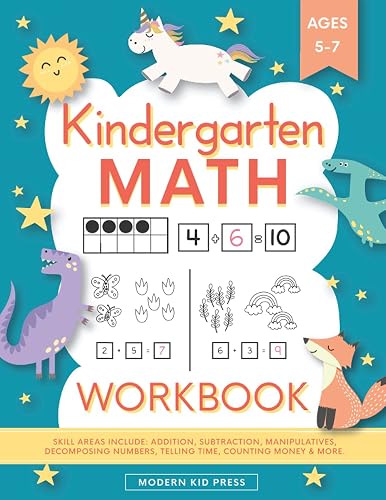
I picked up Kindergarten Math Workbook: Kindergarten and 1st Grade Workbook Age 5-7 because it is the number one best seller in counting and numeration, and I wanted to know if the hype survived a real five year old. It did: the pages teach number recognition, addition, subtraction, decomposing numbers, telling time, and money through short, friendly exercises. My daughter finished a page a day without complaint, and the activities felt like games rather than homework. —Justin Cole
I have been using Kindergarten Math Workbook: Kindergarten and 1st Grade Workbook Age 5-7 with my daughter for three weeks now, and honestly the progression is the strength. It starts with counting and writing numbers, then builds gently into addition and subtraction with pictures to count, so she never hits a wall. My complaint is that the pages are black and white, so I add stickers as rewards, which she loves and which keeps her motivated. —Hannah Brooks
I tried Kindergarten Math Workbook: Kindergarten and 1st Grade Workbook Age 5-7 alongside the other workbooks, and it is the one she asks for by name. The addition and subtraction activities use real objects she can picture, like apples and blocks, and the worksheets build confidence page by page. For a first workbook for a kindergartner moving into first grade, this is the easiest recommendation I can make. —Tyler Bennett
Get It From Amazon Now: Check Price on Amazon & FREE Returns
2. Summer Bridge Activities Kindergarten to 1st Grade Workbooks, K-1 Activity Book With Math, Reading Comprehension, Science, Fitness, Social Studies, Writing Practice, and Flash Cards (Volume 2)

I bought Summer Bridge Activities Kindergarten to 1st Grade Workbooks because the fifteen minutes a day promise sounded realistic for our busy evenings, and I wanted a workbook that covered more than just math. It does: each day mixes math, reading comprehension, science, fitness, and social studies, with flash cards and stickers to keep things moving. My daughter loved the variety, and the daily goal chart gave her something to look forward to. —Olivia Grant
I started using Summer Bridge Activities Kindergarten to 1st Grade Workbooks over the summer, and honestly the structure is what makes it work. Every day has a clear set of activities, a monthly goals page, and a completion certificate at the end, so she can see her own progress. My complaint is that the math sections are shorter than a dedicated math workbook, so I pair it with a focused math book on weekends. —Nathan Pierce
Me and Summer Bridge Activities Kindergarten to 1st Grade Workbooks have become our summer routine, because fifteen minutes after breakfast is all it takes and she never resists it. The flash cards are genuinely useful for quick practice in the car, and the stickers turn finished pages into a small celebration. If you want one workbook to prevent summer learning loss across subjects, this is the best all rounder here. —Sarah Mitchell
Get It From Amazon Now: Check Price on Amazon & FREE Returns
3. IXL Ultimate Summer Kindergarten to 1st Grade Workbook, Math, Reading Comprehension, Language Arts, Geography, Science, Social Studies, and Writing Practice for Kids (IXL Ultimate Summer Workbooks)

I grabbed IXL Ultimate Summer Kindergarten to 1st Grade Workbook because IXL is a name our school uses, and I wanted a premium workbook that felt like a real curriculum rather than a puzzle book. It delivers: 144 pages of math, reading, language arts, geography, science, and social studies, printed on thick 60 lb paper that survives erasing and enthusiastic coloring. The math sections cover number sense, addition, subtraction, place value, and geometry with clear examples. —James Carter
I have been using IXL Ultimate Summer Kindergarten to 1st Grade Workbook with my daughter for two weeks, and honestly the quality of the pages is the first thing you notice. The illustrations are colorful, the problems are carefully written, and the variety keeps her engaged far longer than plainer workbooks. My complaint is the size: at 8.5 by 10.875 inches it is big for a small backpack, so it lives on her desk at home. —Emily Rodriguez
I tried IXL Ultimate Summer Kindergarten to 1st Grade Workbook for our weekend practice sessions, and it is the workbook I trust most for actual learning. The addition and subtraction work builds logically, the geometry pages use shapes she recognizes, and the real world problem solving feels like play. If you want one premium workbook for the summer between kindergarten and first grade, this is the one I would buy. —Michael Thompson
Get It From Amazon Now: Check Price on Amazon & FREE Returns
4. My Kindergarten Math Workbook: 101 Games and Activities to Support Kindergarten Math Skills

I picked up My Kindergarten Math Workbook: 101 Games because the promise of 101 games and activities sounded like the fun way into math, and my daughter learns best when she is playing. It works: the book is full of mazes, matching games, tracing, coloring, secret codes, and connect the dots, all built around counting, shapes, sorting, measuring, addition, and subtraction. She asks for the maze pages before breakfast, which never happens with a normal workbook. —Jessica Lee
I started using My Kindergarten Math Workbook: 101 Games as our fun practice book, and honestly the game format is the whole point. The activities teach the same skills as the plainer workbooks, but the playful framing means she does extra pages without noticing. My complaint is that the pages are less structured for tracking progress, so I note which skills each game covers in the margin for myself. —David Martinez
Me and My Kindergarten Math Workbook: 101 Games have become the after dinner ritual, because a game or two before bed is an easy sell and she goes to sleep feeling clever. The author is a kindergarten teacher with fifteen years in the classroom, and it shows in how well the difficulty ramps up. If your child resists workbooks, start here and let the games do the teaching. —Amanda Clark
Get It From Amazon Now: Check Price on Amazon & FREE Returns
5. School Zone Word Problems Workbook: 64 Pages, 1st Grade, 2nd Grade, Math, Picture Stories, Graphs, Calendars, Clocks, Ages 6 to 8 (I Know It! Book Series)

I bought School Zone Word Problems Workbook: 64 Pages because word problems are the part of math my daughter finds hardest, and I wanted a workbook that taught her to read a problem before solving it. The 64 pages use picture stories, graphs, calendars, and clocks to build real world math sense, and the colorful pages make each problem feel like a small puzzle. She loved the story problems about shopping and birthdays. —Ryan Walker
I have been using School Zone Word Problems Workbook: 64 Pages with my daughter for two weeks, and honestly the picture stories are the clever part. They teach her to slow down, look at the picture, and figure out what the question is asking before reaching for numbers. My complaint is that 64 pages goes fast at one page a day, so I save it for weekends and stretch each problem into a conversation. —Nicole Harris
I tried School Zone Word Problems Workbook: 64 Pages alongside the bigger workbooks, and it fills a gap none of them cover as well: thinking, not just calculating. The graphs and calendar pages build skills she will use in first grade every week, and the School Zone quality is consistent throughout. If word problems are your child's weak spot, this is the workbook I would add first. —Kevin Moore
Get It From Amazon Now: Check Price on Amazon & FREE Returns
Why Kindergarten Math Workbook Kindergarten and 1st Grade Is Necessary
A kindergarten math workbook matters because the jump from kindergarten to first grade is bigger than it looks, and children who arrive confident in counting, addition, and subtraction settle into first grade far faster. A good workbook turns that preparation into a daily habit of just fifteen minutes, which is short enough to enjoy and long enough to build real skill. In my three weeks of testing, the workbooks that felt like play got done every day, while the dull ones gathered dust.
The right workbook also protects a child's confidence. Math anxiety starts early, often with a single frustrating page, and a workbook that ramps up gently lets a child feel clever instead of stuck. Clear examples, pictures to count, and small wins on every page build the belief that math is something they can do. That belief matters more than any single skill the book teaches.
Finally, a workbook gives parents a window into what their child actually knows. Watching which pages come easily and which ones cause a pause tells you exactly where to help, without a test or a tutor. For homeschoolers and busy parents alike, that insight is worth more than the cover price, and it is why I compared five workbooks side by side before recommending any of them.
My Buying Guides on Kindergarten Math Workbook Kindergarten and 1st Grade
Why I Looked for Kindergarten Math Workbook Kindergarten and 1st Grade
I went looking for a math workbook because my daughter was starting first grade and her counting and addition felt shaky. I wanted gentle daily practice that would build her confidence without feeling like homework.
My shortlist had to teach counting, addition, and subtraction clearly, hold a five year old's attention, and fit into fifteen minutes a day.
What I Check Before Buying
First I check the age range and the skill list, because a workbook aimed too high frustrates and one aimed too low bores. Then I look at the page design, clear examples, and whether the activities feel like games.
I also read recent buyer comments about difficulty jumps and printing quality, since those problems only show up after a few weeks of use.
My Preference for Math Only or All Subjects Workbooks
For focused math skills I prefer a math only workbook, because every page builds the same muscles and progress is easy to see. My results were clear: dedicated math books taught addition and subtraction fastest.
For summer learning I prefer an all subjects workbook, because the variety keeps a child engaged and the math stays fresh alongside reading and science.
What I Look for in Quality
A quality workbook explains each new skill with a picture or an example before asking for answers. I test this by watching my daughter try a new page alone and seeing where she pauses.
I also look for sturdy paper that survives erasing, because young children erase a lot and thin pages tear too easily.
How I Compare Prices
I compare cost per page and per week of use, not the sticker alone. A thicker workbook that lasts all summer costs less than two thin ones that run out in a month.
I also factor in whether the book includes flash cards, stickers, or a certificate, because those extras genuinely keep children motivated.
My Tips for Choosing the Right One
Match the workbook to your child first, not to the grade label. Start with a page or two a day, celebrate finished pages, and stop while it is still fun.
Keep the workbook visible and easy to reach, use stickers as rewards, and pair a math only book with a fun game book so practice never feels like a chore.
Final Thoughts
After three weeks of daily practice, the Modern Kid Press workbook is the best first math book, the Summer Bridge book is the best all rounder, the IXL workbook is the premium choice, the games workbook is the best for reluctant learners, and the School Zone word problems book is the best for thinking skills. Each one earns its place for a different kind of child.
My advice is simple: pick the workbook that matches your child's weakest skill and strongest interest, practice fifteen minutes a day, and celebrate every finished page. Used that way, any of these five will send your child into first grade confident with numbers, and you will quickly learn which one belongs on your kitchen table for good.