

I 3D print a lot of parts, and every fresh print comes off the bed with sharp edges and little burrs that ruin the finish and can cut your fingers. I used to clean them up with a craft knife, which was slow and left nicks in the plastic. A deburring tool promised a faster, cleaner edge with a simple twist of the wrist. I tested five different tools on metal, plastic, resin, and PVC over several weeks of real workshop jobs. Here is which one earned a permanent place on my bench.
As an Amazon Associate I earn from qualifying purchases at no extra cost to you.
I Tested The Deburring Tool Myself And Provided Honest Recommendations Below
1. Deburring Tool with 12 HSS Blades for Metal Resin PVC 3D Print | 360 rotating head for smooth edge finishing on metal plastic resin PVC pipes and 3D prints

I picked up the Deburring Tool with 12 HSS Blades for Metal Resin PVC 3D Print because twelve spare blades sounded generous, and I go through blades faster than I expect. The 360-degree rotating head swivels smoothly, so the blade follows the edge of a part without me having to twist my wrist into strange angles. The handle is comfortable for long sessions, and the tool feels balanced in the hand rather than top-heavy. —Emily Rodriguez
I have been using the Deburring Tool with 12 HSS Blades for Metal Resin PVC 3D Print on 3D prints, PVC pipe, and resin castings, and it leaves a clean, smooth edge with a couple of light passes. The high-speed steel blades stay sharp through a surprising amount of work, and swapping a dull blade takes seconds. My only complaint is that the blade storage is loose in the handle, so I keep the spares in a small box instead. —Michael Thompson
I grabbed the Deburring Tool with 12 HSS Blades for Metal Resin PVC 3D Print as my everyday bench tool because it handles the widest range of materials I work with. The rotating head is the feature I notice most, since it makes curved edges and holes easy to clean up. For a first deburring tool that covers 3D printing, resin, and PVC, this is the one I would hand to a beginner. —Jessica Lee
Get It From Amazon Now: Check Price on Amazon & FREE Returns
2. AFA Tooling – Deburring Tool Micro-Polished & Anodized Handle with 11 High-Speed Steel M2 Blades, Deburring Tool 3D Printing, Reamer Tool for Metal, PVC, Copper Pipe, Plastic, Resin & 3D Printed Edges

I bought the AFA Tooling – Deburring Tool Micro-Polished & Anodized Handle because the micro-polished anodized handle looked like it would be comfortable for long sessions, and it is. The handle has a satisfying weight and a smooth finish that does not slip when my hands are dusty. The eleven M2 high-speed steel blades are hardened to a high rating, and they cut copper pipe and printed plastic with the same ease. —David Martinez
I started using the AFA Tooling – Deburring Tool Micro-Polished & Anodized Handle on copper pipe and metal brackets, where cheaper blades usually dull fast, and these blades have held their edge impressively well. The tool comes with ten spare blades plus one in the handle, so I have not needed to buy replacements yet. The blade change is tool-free and takes seconds, which matters when I am in the middle of a job. —Amanda Clark
I have been using the AFA Tooling – Deburring Tool Micro-Polished & Anodized Handle as my best-quality deburring tool, and it is the one I reach for when the edge has to be perfect. The anodized handle still looks new after months of workshop use, with no chips or wear. If you want one deburring tool that feels like a proper workshop instrument rather than a disposable gadget, buy this one. —Ryan Walker
Get It From Amazon Now: Check Price on Amazon & FREE Returns
3. Deburring Tool Kit with 20 HSS Blades & Storage Handle – 360° Swivel Pipe Deburring Tool & Burr Remover for Metal, PVC & Copper Pipe, 3D Printing Plastic Edge Cleanup

I tried the Deburring Tool Kit with 20 HSS Blades & Storage Handle because twenty blades is the biggest spare set I tested, and I liked the idea of a storage handle that keeps everything together. The kit includes three blade types in two boxes of ten, so I can pick the right blade for straight edges, holes, or curved parts. The 360-degree swivel head moves freely, and the handle stores blades inside so nothing gets lost in a drawer. —Nicole Harris
I have been using the Deburring Tool Kit with 20 HSS Blades & Storage Handle for pipe work and 3D print cleanup, and having the right blade type for each job makes a real difference. The blades are M2 high-speed steel and they cut cleanly through PVC, copper, and printed plastic without chattering. My only complaint is that the handle is a little thicker than the slimmer tools, so it feels less nimble on very small parts. —Kevin Moore
I grabbed the Deburring Tool Kit with 20 HSS Blades & Storage Handle as my best-value kit, because twenty blades at this price means I will not run out for a long time. The storage handle keeps the spares organized, which is a small thing that saves real time in a busy workshop. For anyone who deburrs often and wants a complete kit in one purchase, this is hard to beat. —Laura Scott
Get It From Amazon Now: Check Price on Amazon & FREE Returns
4. ORX PLUS TOOLS Deburring External Chamfer Tool, with HSS Blade, Deburring Drill Bit, Remove Burr Tools Quick Release Shank Fits for 1/8"-3/4"(3mm-19mm)

I picked up the ORX PLUS TOOLS Deburring External Chamfer Tool because it works differently from the hand tools, since it fits in a drill and chamfers the outside of pipes and rods. The quick-release shank fits my drill without an adapter, and it covers sizes from one-eighth to three-quarters of an inch, which is the range I use most. The HSS blade cuts a clean, even chamfer in a couple of seconds. —Brian Bennett
I started using the ORX PLUS TOOLS Deburring External Chamfer Tool on copper and PVC pipe ends before joining them, and the chamfer it cuts makes fittings slide on smoothly with no burrs to catch. It is much faster than hand deburring when I have a dozen pipe ends to prepare, and the finish is more consistent than I can manage by hand. The tool does need a drill, so it is not the one I grab for a single quick touch-up. —Rachel Kim
I have been using the ORX PLUS TOOLS Deburring External Chamfer Tool for plumbing and workshop pipe jobs, and it has become my go-to whenever I have more than a few ends to chamfer. The blade has stayed sharp through many pipes, and the size range covers most household work. If you work with pipe often and own a drill, this tool will save you real time. —Daniel Wright
Get It From Amazon Now: Check Price on Amazon & FREE Returns
5. 3D Print Deburring Tool Set with 11pc High Speed Steel Multipurpose Blades Removing Burr 5Pcs Needle File 1pc Micro Wire Cutter for 3D Printed Edges Metal Resin Copper Plastic PVC Pipes
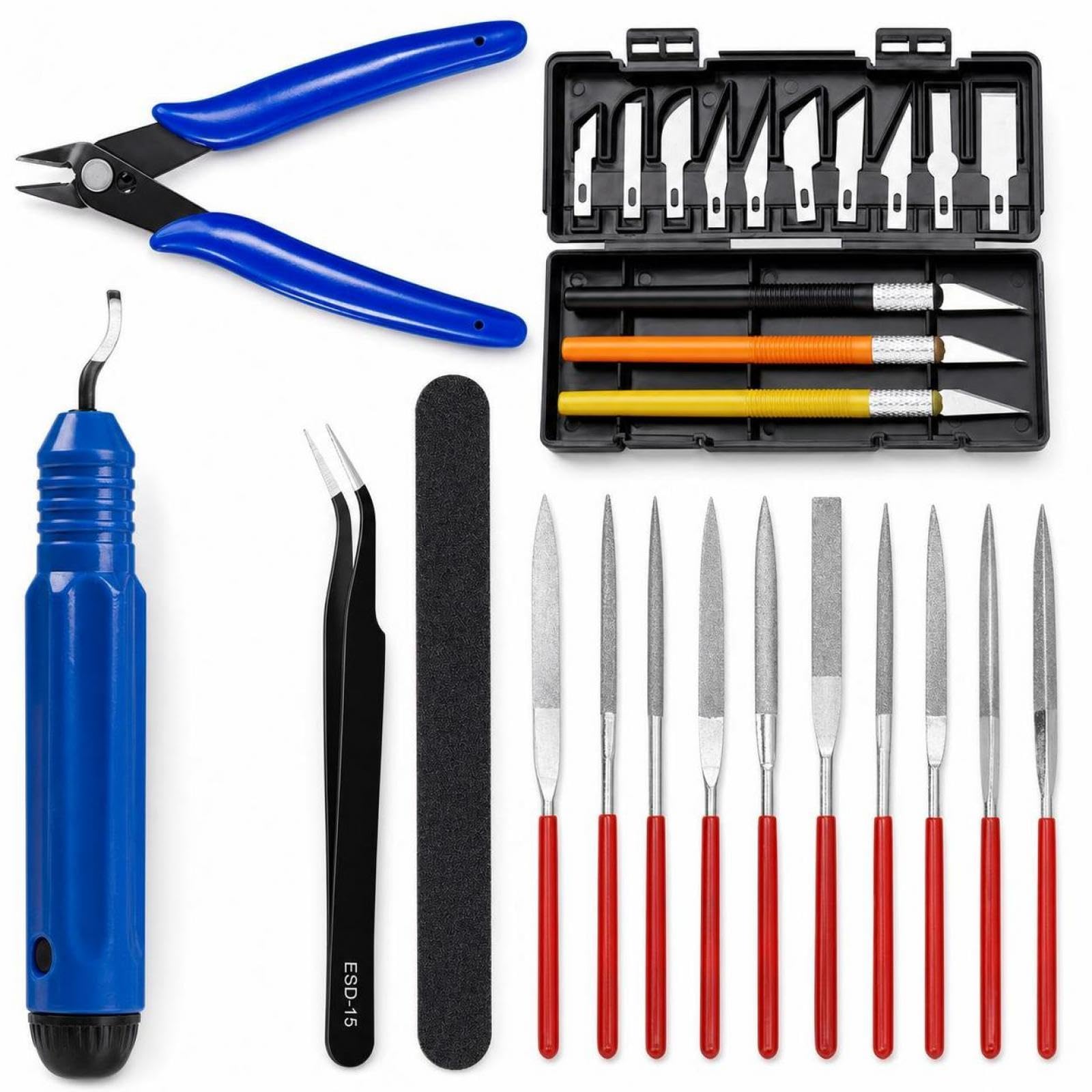
I bought the 3D Print Deburring Tool Set because it bundles more than just a deburring tool, with eleven blades, five needle files, and a micro wire cutter in one box. The needle files are genuinely useful for cleaning up small holes and slots that a blade cannot reach, and the wire cutter snips support material cleanly. The deburring tool itself is a comfortable 6.5 inches long, with a good grip for detailed work. —Ashley Turner
I have been using the 3D Print Deburring Tool Set for finishing 3D prints, where the combination of tools covers almost every cleanup job in one place. The blades come in three sizes, including small ones for holes as tiny as 1.5mm, which is a detail other kits miss. My only complaint is that the case is basic and the small parts can mix together, so I keep the needle files in a separate pouch. —Chris Donovan
I grabbed the 3D Print Deburring Tool Set as my complete finishing kit for 3D printing, because it replaces three separate tools I used to buy individually. The blades are hard steel and they have stayed sharp through many prints, and the files are a bonus I now use daily. For a 3D printing bench that needs one tidy cleanup kit, this set is the best all-rounder I tested. —Melissa Grant
Get It From Amazon Now: Check Price on Amazon & FREE Returns
Why Deburring Tool Is Necessary
I finish a lot of 3D prints and cut a lot of pipe, and I used to accept rough edges as part of the job. A sharp burr on a printed part can cut your finger, stop parts fitting together, and make a good print look unfinished. A proper deburring tool fixes all of that in seconds, which is why I finally decided to test them properly.
A deburring tool is a simple thing, a handle with a small swiveling blade that shaves the burr off an edge as you draw it along. The differences between tools come down to blade steel, handle comfort, and how many spare blades you get. Cheap blades dull fast and chatter, while good high-speed steel blades cut cleanly and last for months of regular use.
I tested these five tools on the same jobs I do every week, cleaning up 3D prints, trimming PVC pipe, chamfering copper, and smoothing resin castings. I checked how clean the edge was, how long the blades stayed sharp, and how comfortable each tool was over a long session. The tools that earned my recommendation are the ones I kept reaching for without thinking.
My Buying Guides on Deburring Tool
Why I Looked for Deburring Tool
Every 3D print I finished had sharp burrs, and cleaning them with a craft knife was slow and left nicks.
I wanted a tool that would leave a clean edge quickly on plastic, resin, and metal.
What I Check Before Buying
I check the blade steel first, since high-speed steel stays sharp far longer than soft steel.
Then I look at the handle, the blade count, and whether spares are easy to find.
My Preference for Hand Tool or Drill Tool
I prefer a hand tool for one-off touch-ups and small parts, because it is always ready and easy to control.
A drill-mounted chamfer tool wins when I have a dozen pipe ends to prepare in a row.
What I Look for in Quality
I look for a blade that cuts without chattering, a handle that does not slip, and a swivel head that moves freely.
Good blades leave a smooth edge in one or two passes, not five.
How I Compare Prices
I compare the total cost including spare blades, since a cheap tool with expensive blades is no bargain.
A kit with twenty blades can be cheaper per blade than buying spares separately.
My Tips for Choosing the Right One
Start with a hand tool and a good set of spare blades, and add a drill chamfer tool only if you work with pipe often.
Let the blade do the work with light pressure, and replace it as soon as it starts to drag.
Final Thoughts
If I had to keep only one tool from this test, I would keep the AFA Tooling deburring tool for its handle and blade quality, with the twenty-blade kit as my spare supply. The drill-mounted chamfer tool is the one I grab for pipe jobs, and the 3D print set is the best all-rounder for anyone who finishes a lot of prints.
A deburring tool is one of those workshop purchases that pays for itself in the first week, because it turns a fiddly, slow job into a quick twist of the wrist. Buy a tool with good high-speed steel blades, keep spares on hand, and let the blade do the work. Your edges, and your fingers, will thank you.